

Data sovereignty has rapidly become an important consideration in managed hosting for UK businesses. Once viewed as a technical detail best left to IT providers, it is now firmly a commercial, legal, and reputational issue.
Data sovereignty refers to the principle that data is governed by the laws of the country in which it is stored and controlled. In practical terms, it determines where your data lives, which legal system applies to it, and who can compel access to it.
For organisations operating in today’s uncertain regulatory and geopolitical climate, particularly in the post‑Brexit UK, understanding data sovereignty is no longer optional. It affects compliance, risk exposure, customer trust, and long‑term business resilience. Choosing where and how your data is hosted has become a strategic decision rather than a purely technical one.
Why Data Sovereignty Has Moved Up the Agenda
In recent years, awareness of data sovereignty among UK businesses has grown sharply. Brexit has been a major catalyst, prompting organisations to reassess how international data flows affect their obligations under UK data protection law. While the UK currently maintains a data adequacy agreement with the EU, allowing personal data to move freely between the two, the broader international picture is far more complex and subject to change.
Industry research consistently shows that many UK SMEs do not know where their data is physically stored. Even fewer understand which country’s laws apply to it. This lack of visibility creates risk. Businesses may assume their data is protected under UK law because their provider markets “UK hosting”, when in reality the provider itself may be foreign owned and subject to overseas legislation.
Concerns are particularly strong around US‑owned hosting providers. Under US legislation such as the CLOUD Act, American authorities can lawfully require US‑based companies to provide access to data, regardless of where that data is stored. This means data belonging to a UK business, even if hosted in a UK data centre, could potentially be accessed under US law without any involvement from UK courts.
It is these legal realities that have driven data sovereignty from a background IT topic to a boardroom discussion. The UK government has acknowledged this shift by classifying data centres as critical national infrastructure, highlighting the strategic importance of keeping digital assets secure and under domestic oversight.
Hosting Ownership Models and Legal Jurisdiction
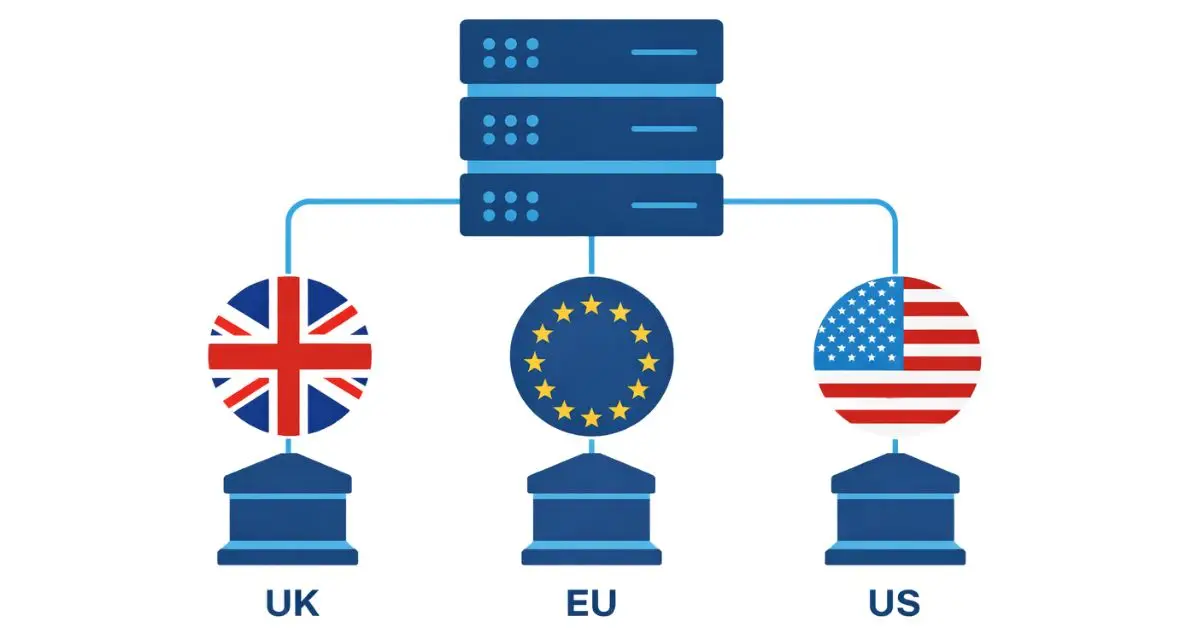
When assessing data sovereignty, server location alone is not enough. Ownership and jurisdiction are equally important. Different hosting models carry very different implications for how data is governed.
- A UK‑owned and UK‑incorporated hosting provider operating UK data centres offers the clearest and simplest sovereignty position. Data remains within the UK and is subject solely to UK law. For many businesses, particularly those handling sensitive or regulated data, this clarity significantly reduces legal and compliance risk.
- EU‑based providers also operate under strong privacy frameworks through GDPR. They can be a suitable option for some UK businesses, especially where EU operations are involved. However, they remain foreign entities, and future divergence between UK and EU regulatory frameworks could introduce additional complexity.
- US‑owned providers present the most challenging data sovereignty scenario. Even where data is stored in the UK or Europe, it may still fall under US legal jurisdiction due to company ownership. This often necessitates additional contractual safeguards and risk assessments, adding administrative overhead and uncertainty.
Independent UK providers, particularly specialist managed hosting companies, often offer the highest levels of transparency. Clients can usually identify exactly where their data is hosted and who is responsible for it. This level of openness is increasingly valued by organisations seeking control rather than scale at any cost.
The Often Ignored Risk of Overcrowded Hosting
While data sovereignty addresses legal control, hosting quality also depends heavily on how infrastructure is managed. One of the most overlooked risks in hosting is server overcrowding.
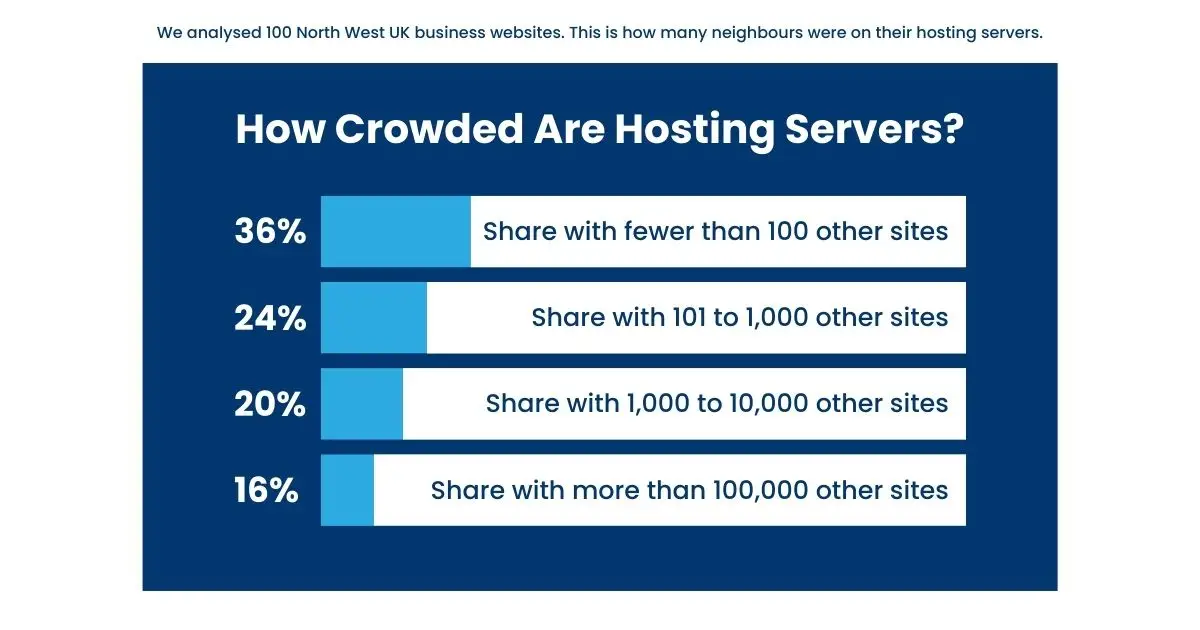
Many mass‑market hosting providers rely on aggressive overselling, placing hundreds or even thousands of websites on a single physical server. While this keeps prices low, it introduces serious performance and security risks. When too many sites compete for the same processing power, memory, and bandwidth, performance becomes unpredictable. Slow load times, intermittent outages, and instability during traffic spikes are common symptoms.
Our own analysis of business websites across the North West revealed a startling variation in server density. Some sites shared servers with a few dozen others, while some, including ecommerce websites, were hosted on infrastructure shared with hundreds of thousands or even millions of domains. In such environments, businesses have no visibility or control over their digital neighbours.
Security risks increase as server density rises. A compromised site can be used as a stepping stone to attack others on the same server. Email deliverability is another frequent casualty. Shared mail servers and IP addresses mean that one misconfigured or compromised site can damage the sending reputation for every business on that server, causing legitimate emails to be blocked or filtered as spam.
Cheap hosting often appears cost‑effective until these hidden risks surface, usually at the worst possible time.
Our Approach to Data Sovereignty and Managed Hosting
At 127 Media, managed hosting has been central to our business since we started in 2014. Over more than a decade, we have refined our approach based on real‑world experience supporting UK businesses across multiple sectors. Hosting is not an add‑on for us, it is a core service that underpins everything else we do.
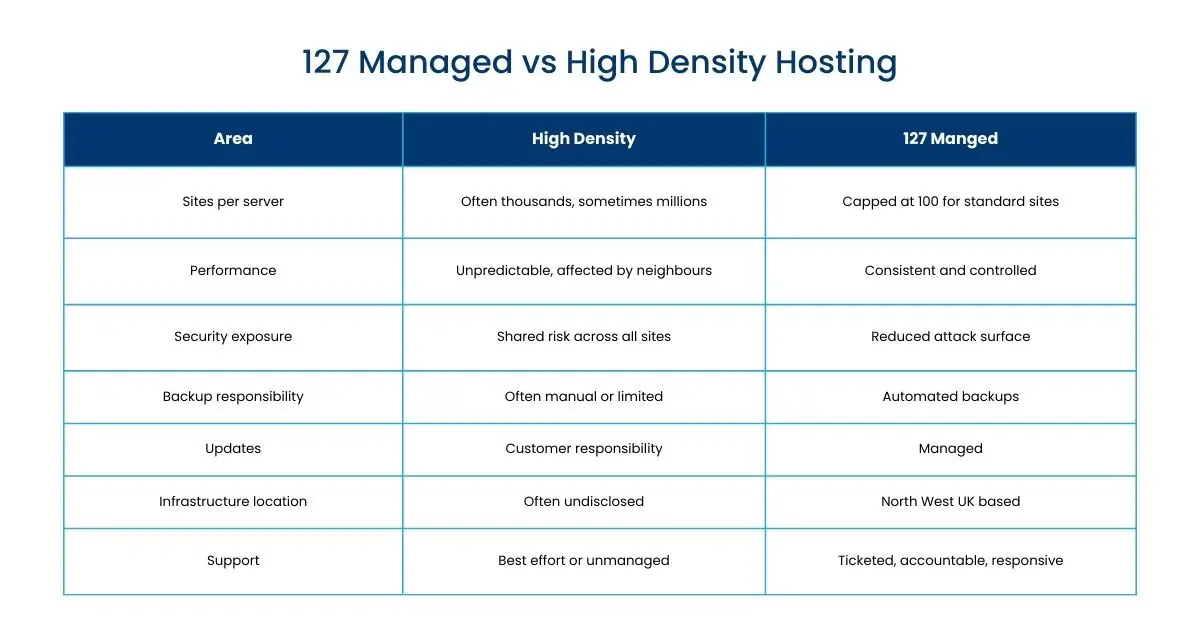
Our infrastructure is entirely UK‑based and operated under UK jurisdiction. Client data does not leave the UK, and there are no overseas parent companies or legal frameworks involved. This provides absolute clarity around data sovereignty and compliance.
We take a deliberately conservative approach to server density. For standard website hosting, we cap servers at a maximum of 100 websites. This ensures consistent performance, reduces risk, and avoids the problems associated with noisy neighbours. Our philosophy is simple, it is better to run servers responsibly than to squeeze every last account onto a single machine.
All managed sites benefit from automated, UK‑based backups, stored separately from the live environment. Recovery procedures are tested and documented, ensuring data can be restored quickly if needed.
For platforms such as WordPress, we manage core and plugin updates as part of the service. Outdated software remains one of the most common causes of security breaches. By keeping systems current, we significantly reduce exposure to known vulnerabilities.
Security is built in at multiple levels. Network firewalls, hardened servers, malware scanning, application‑level protection, and encrypted connections all work together to protect data and services. No single control is relied upon in isolation.
Support is delivered by UK‑based engineers who understand the environments they manage. All requests are handled through a tracked ticketing system, ensuring accountability and clear communication. Clients deal with people who know their systems, not anonymous call centres.
Why Data Sovereignty Is a Competitive Advantage
Data sovereignty is increasingly a trust signal. Clients, partners, and regulators want assurance that businesses understand where their data is hosted and how it is protected. Organisations that can demonstrate control and transparency are better positioned to win trust and avoid regulatory surprises.
Choosing a sovereign managed hosting provider is not just about compliance. It is about performance, reliability, accountability, and long‑term risk management. Businesses that take control of their hosting environment are better equipped to handle growth, change, and uncertainty.

Keeping Your Data Under Your Control
For UK businesses that value clarity, control, and resilience, data sovereignty should be a central consideration when choosing a hosting partner. Keeping data under UK legal protection reduces uncertainty, simplifies compliance, and aligns infrastructure with national standards and expectations.
At 127 Media, we believe hosting should support your business rather than introduce hidden risk. Our managed hosting services are designed to deliver security, performance, and peace of mind, without compromising on sovereignty or service quality.
If you are reviewing your current hosting arrangements or have concerns about data sovereignty, performance, or security, we are always happy to talk. Your data is one of your most valuable assets. Where it lives, and who controls it, matters more than ever.